There is an unusual and foreign aspect of off-the-grid living not often mentioned in many books, articles or blogs like mine and yet it is an important issue. I am talking about the type of ownership of land.
Most of us are familiar with conventional structures of ownership from fee simple to strata title, from leasing to housing co-ops. But buying land off-the-grid has often required more creative means of ownership and, where it wasn’t required, it was chosen or has evolved. The reasons for this are myriad but, essentially, it boils down to this: the property you are buying is not in the city and all the rules we grew up with were written for that venue. And also because banks don’t like to finance remote properties. Let me explain (in part):
Purchasing individually is clearly the simplest (fee simple) and the most common way to ‘own’ land (although we never own land, really. We just rent it by way of increasing taxes from the government. Don’t pay the taxes and they take your land. So, was it ever really yours?).
But, when buying rural, the tracts of land are usually in larger chunks and, perhaps, the use of the land will only be seasonal. Or one in which the main feature of the property is something that should or must be shared (like a lake). So, it often makes more sense to buy with others. Whatever. Bottom line: a lot of parcels are bought by groups.
It’s not always easy. We bought our 86 acre property with a group of ten only to discover that the government later dictated that any subdividing would require lots no smaller than ten acres. By bureaucratic standards, we now had two partners too many. So, eventually six of us bought four of us out. We six now fit nicely into the ‘paper rule book’ should it ever come to that. And we hope it never does.
We seem to do just fine by neighbourly cooperation rather than lines, boundaries, rules and regulations. But we have a few. And we won’t likely ever subdivide (the topography does not lend it self to that, anyway) which would reinforce the regional district rules and regs on our lives. Why should we want that when it is working fine as it is?
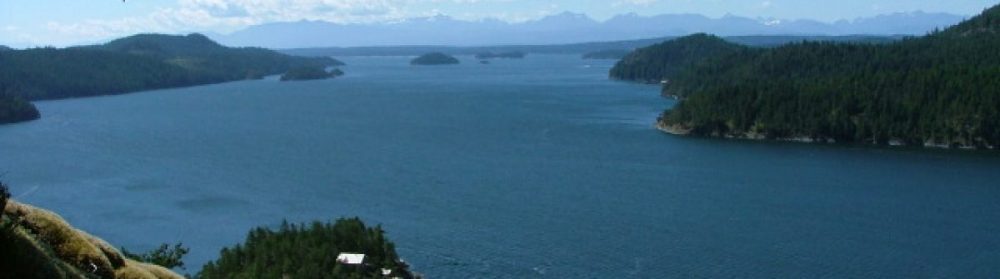
And, anyway, to do that would require roads being built on a parcel of our land that would do us no good (it may be a regional district benefit but not one we need) and that we wouldn’t/couldn’t use. We are, essentially, a water access only community.
It is not that the local government is bad. Stupid, perhaps. Definitly narrow minded. But not evil. It is just that so much of their ‘paper rule book’ was written for ‘planned neighbourhoods’ and many of the concepts enshrined and enforced by bureaucracy simply don’t fit an off-the-grid site. Especially a water-access only one.
Our company structure is a sufficient means of holding title. We pay our taxes and build to code and generally obey all rules and regulations that pertain to us but so many aren’t applicable and so we adjust accordingly. Parking regulations, for instance, simply do not apply. We don’t have cars over here. But boat mooring does, so we obey the rules and restrictions and share the solutions as a group.
Other groups got together during the hippy era when co-ops seemed all the rage. And I suppose they work. Somewhere. But, generally speaking, co-ops often don’t work well when the use and or involvement in the subject property varies greatly with the members. It is difficult to ‘share’ and ‘manage’ equally on everything with full-time, part-time, sporadic and absentee participants. Especially when all those different users have equal votes. Co-ops are not the recommended route for off-the-grid holdings.
Having said all that, buying in a group and then subdividing later into generous chunks is a good way to go if you can agree on an imaginary subdivision in advance (or agree in advance never to subdivide) and then endure the bureaucratic process of making it so. But you should also know that subdividing ain’t cheap. Road building alone (intended to tie you to the grid) can be hellishly expensive.
Personally, I feel I need at least five acres and ten is better. I don’t raise sheep or even chickens (tho our worm bin is expanding!) but I do need the sense of space. I love the quiet. I like not looking into my neighbour’s back yard. I just like it. So, I need/want space and that means a larger parcel and that means partners for affordability.
So, to wrap up: I would advise looking at larger parcels. They are cheaper on a per acre basis. I’d try finding friends and decent acquaintances with whom to buy it with. Bear in mind, you rarely get to choose your neighbours anyway so you don’t have to love the ones you buy with. But start with respect at the very least. They should be honest and responsible. You must, however, agree on how to own it together and that agreement must include a good dispute resolution mechanism. You will definitely use it!
And, all things being equal, I would recommend a company structure at first, with the longer term goal of a strata title or subdivision (in maybe ten years time? Maybe never) so that you eventually achieve some kind of sole ownership.
One that you ‘rent’ from the government, of course.
 Our Off the Grid Home