One hundred years ago (give or take) there were a lot of people up here. In fact, there was once an aboriginal village on a narrow passage that was so populated that it was not expected that any one person in the village would know everyone else! That’s beyond village in my books. That’s a town!
It was also a bona-fide community. Campbell River hardly existed back then. This was the centre of their universe!
At one point, there were five hundred non-aboriginal people living in the channel to the west of us. Now there are maybe thirty. And my island once had three times the population that it has now.
The reasons for this, of course, are obvious and can be summarized nicely by the term, urbanization. Before that tidy word, we had industrialization and modernization. The implication in the terminology is clear: we are evolving, improving and living better. Go urban or devolve.
Put more bluntly: there is a death threat warning being broadcast to all small communities.
Already the vast majority of the Canadian population lives in cities and this inner migration phenomena is playing out all over the world. The trend is likely to continue. Progress, eh?
But that trend didn’t influence those who stayed here, those who came here and those who are living here now. It doesn’t seem to include those planning and preparing to come here tomorrow. Why not? What is it that makes people ‘buck the trend’ and choose to ‘live freely a harder life with fewer rather than more modern conveniences’? Are they just nuts?
The reverend Alan Greene (Columbia Coast Mission) wondered that same thing back in the 1930’s and concluded in his journal at the time that “it was their need for independence.”
I don’t think that’s it. Not entirely. I think man is mostly a social animal and isolation, separation and, in some cases, deviation, is not their chosen path to happiness and fulfillment. I think even the most eccentric amongst us wants to belong a bit. Once in a while. Somewhere. Put more succinctly, I think we all crave a little community now and then. And, more than that, we want to be members in that community, not guests or visiting strangers.
“So, then, why do it? Why live remote? Why go feral? What kind of community is in it for you way out there?”
My first thought is that it is not about ‘what you get’ in the way of community. I had no idea when we arrived what community might look like when I got out here. I think it is more about what you don’t get. I think the urban-type-who-goes-feral is really fleeing the order, the controls, the rules, the restrictions and the overwhelming presence of authority they see and experience in their current city-based lives. So, in that way we, ‘the fleeing’, are seeking less-of-what-passes-for-community-in-the-city, to be sure.
Of course, in that way, it is the same thing as Rev. Green said. we seek independence. But I am shading that idea a bit darker. I think that we first experienced civic claustrophobia. Civic dystopia. Too much overbearing community. I think we first felt unhappy in the row house, the apartment building and the cul-de-sac and then we jumped from the frying pan into the great outdoors.
And who can blame us? It has only gotten worse, it seems. In the last decade community has morphed into BIG BROTHER much as I sensed and feared it would when it was just a bit too much of a restrictive and claustrophobic community. Now we have CCTV and gas-passing police tasering, shooting, and harassing people. We have gangs-at-war, escalating housing costs, longer commutes, bad air, polluted water, diminishing quality of life and worse, fear of each other rather than a sense of community with each other.
So, to me, the off-the-gridder still wants community but simply doesn’t like the kind on offer in the city. And most of us that come from the city – even those who came years ago with the back-to-the-land movement of the seventies – really don’t know what kind of community we are wanting, getting in to or are working towards when we get here. We don’t know what we are doing. Community building is a lost art.
Of course, we tend to follow the old patterns of community building somewhat. It’s a path, of sorts. We hope for enough kids to justify a school. We build and frequent a community hall. We help one another through various tests, trials and challenges. And, of course, like all good people, we share and give generously to the local common weal. And we socialize.
But regular potlucks is not enough. The pressures to move to the city are too great. And we are too weak in that regard. Our community currently isn’t sexy enough to ensure sustainability.
Gut wrenching reality fact: sexting and texting seems to bond people better than potlucks.
Don’t get me wrong – the appeal of the hinterlands hasn’t diminished. Not a bit. Not even the potlucks. In fact, whenever the country is directly compared to the city it is like comparing Shangri-la to Calcutta’s sewers. Looking at them that way makes the choice or the decision easy. For anything.
But the pressures are still there. They are subtle, though. They are indirect. They are unhealthy. They are wrong. And they are sneaky. But they are damned effective. Let me explain…………
The ferry system (for instance) doesn’t directly serve the urban communities (for the typical young urban Vancouverite in the west end or Yaletown, they may use the ferry for infrequent summer time recreational purposes or even less). BC Ferries, by original design and annual usage, mostly serves the gulf and Vancouver island communities. And the ferry system is not working very well due to lack of funds and proper management focus (they forgot who their main customer was).
The result: regular and especially gulf island-based ferry users are considerably more inconvenienced than their city counterparts. More than they originally bargained for anyway. Older and younger people experience even greater hardship due to costs and poor transit connections. Hardship = pressure. Pressure seeks relief. Relief = city living.
We are also taxed pretty highly out here. Especially when considering the dirth of services. Less services + higher costs = pressure. Pressure seeks relief. Relief = city living.
You can repeat that formula for just about everything from communication to food shopping, from doing business to visiting friends and family, from transportation to casting your vote. Living out here is hard and they purposefully make it harder.
“Ya know, this island thing is just too inconvenient. Plus we are getting older. Maybe we should move back to the city?” (my parents in the 70’s when they needed a bit more attention)
At some point almost everyone on an island entertains that thought at one time or another. The government does not support as much those who live rural compared to those who live urban. Period. Not by a long shot.
“Dave, you gettin’ wimpy on us?”
No. No! A thousand times no! In fact, it is the opposite of wimpiness I am talking about. I am suggesting facing the reality of it is all. I think we have to kick it up a notch to survive. Community-wise, I mean. And I don’t mean protesting. That is ‘old’. That is negative. It is not the constructive way to do it.
We off-the-gridders thought outside-the-box and then went one step further and got-outside-the-box. But the box is still a big influence and we may have to look away completely. Being outside and yet still looking in is not good enough. It generates protest but nothing else. We have to learn to build community out here. On our own terms. We have to have a blend of old (potluck dinners) and new (modernization projects, community projects, etc.). This is a lifestyle so utterly fanatstic that it should not be threatened in the least by such mudanities as ferry service or the price of gasoline, of government policies or services.
If we are truly independent then we are going to have to simply get more creative.
I am kinda lookin’ forward to it. But it is a bit of a challenge, don’t you think?
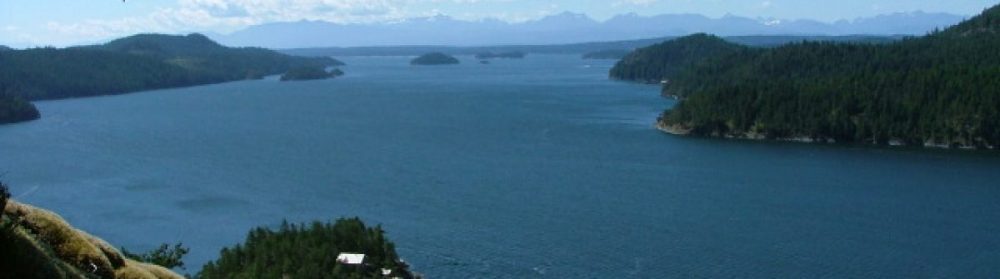


 Our Off the Grid Home