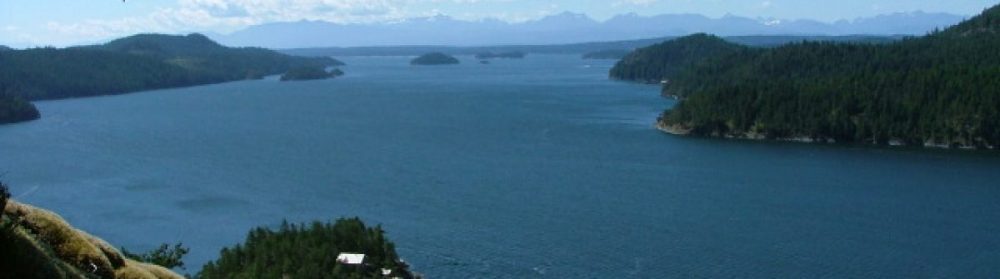
Another day in the life


Yesterday was simple.  Lift wood, carry wood, float wood, stack wood.  Then lift some more.  A chore difficult to get wrong.  It would be a challenge to screw it up, really.  But we managed to flirt with danger at least and, at the end of the day, found ourselves only half-way done.  Some things are more difficult than they look.

This pile of wood – about 24 pieces of big 2-bys (wet, of course) started out at my neighbour’s dock where they had been dropped by the barge last week,  We intended to take the bulk of them to the bottom of our highline for lifting up to our site later that day, along with a few salvaged logs that were already waiting at the bottom end on the beach.  The balance of the wood would be taken around the peninsula to the shore out front of our house.  Both of these actions required loading wood on a boat.  Sally’s little whaler was the boat selected.

‘Course the dogs had to come, too.

I also have to float a 40 foot section of steel catwalk out around the peninsula to the shore in front of the house and get it high enough to beach and then remove the attached floats with a mini-grinder.  After that is done, the catwalk is to be flipped over and dragged and lifted up onto the small steel base that I described building last week.  It should sit at a 23 degree incline and give us better access from the beach than does the lethal stairs currently employed as the main access.

Deadly as they are, I have yet to hurt myself on those stairs in eight years (one of the few places on the site that has no blood stains).  I may not be able to say the same thing for getting a two-ton ramp in place.

None of this is rocket science but all of it is bull-work.  It seems that everything has to be lifted and carried at least several times.  If there is a continuing theme to living remote it is that ‘you spend a lot of time carrying heavy things’.  It’s like a curse.  It’s like some primitive God of the forest has condemned you – for the rest of your life – to carry double your weight again and again every day.  I swear I carry, on average, 600 pounds over the course of any given day at the very least.  If it is an official lifting day, then you can triple that easily.

Have I mentioned my mild obsession with winches? 

I shouldn’t say ‘I’.  Sally is lifting right along beside me and, to be fair, proportionally more.  She is half my weight and, although I take the bulk of the heavy stuff, sometimes she simply has to take the other end of something too heavy for just me.  And even if I carry three one hundred-pound beams, she might have to carry ten thirty-pound pieces to help out.  It all adds up.

Sally is fit.  She is also strong-like-bull.  And she looks healthy and beautiful.  By comparison, I am a little chunky and look like a bull.  Hard physical work seems to affect us differently.  And, as I said, we are only half way done on this one chore.  Who knows what I will eventually grow into…….

Anyway, it is Sunday and we have downed tools and muscles.  We are going over to the neighbouring island.  They are hosting a traditional-cum-hippified Fall Fair.  They compare quilts and pies and have a petting zoo.  They put wheels on zucchinis and race them.  Everyone sees their neighbour.  It’s a day off.  Way off!  No heavy workout except for the smile muscles.


Reflections

This is NOT really a post.  It is a diary entry.  I was ‘messing about’ with keeping a journal in 2002/2003 and tried this on…………..It is not particularly good but it was written in the moment that was then and kind of illustrates what we were going through in the early days. 

“We have enough food to feed an army!” I said as I hoisted the second large cooler up the stairs to the deck.  Another large box of dry goods and a few more bags of impulse purchases filled the larder to the point of excess and, given our lack of refrigeration, clearly indicated poor planning.  We had too much.  Or so I thought.

“Sweetie, don’t forget Sue is coming on Tuesday and Doug said that he’d come by the following weekend.  And Emily  will be with us for the next few days.  I think we’ll be fine”.  I assumed that she was right.  She usually is.

We had packed and prepared for two weeks working at the site.  We had recourse, of course, to the store on the next island, but we already had more inventory than they did so I relaxed.  We settled down to a heavy schedule of recreational building (please refer to previous articles for a definition of recreational building and the first-aid tips that accompany it).

Early the next morning after breakfast I dragged out the tools, the generator, the materials and I began the random series of steps I undertake when trying to build something. I never really know exactly where to start so I often start the genset first just to create the right atmosphere.  As a consequence of all that noise, I failed to hear the footfalls of my neighbour coming to greet us.  Genset shut off, we all sat down to a nice cup of tea and Sally broke out a few cookies and bits of fruit. They left just before noon.

On went the generator and, since I had passed the time planning my next few steps, things got underway – until Linda passed by and I made the mistake of waving.  Linda is a more distant neighbour and tends to interpret a hand waving as an invitation to lunch.  Her timing was perfect and we enjoyed her long missed company until she continued on her way an hour or so later.  I tentatively lifted a hammer and, checking to make sure that no one was approaching, began to hit things – some of them were nails.

Just as I was getting my hammering sighted in and could claim more nail hits than misses, we were hailed from the shore once again.  Neghbours from the North this time.  Nice people.  Long time, no see.  More tea.  More cookies.  Lots of nice chit chat.  Hammer rested with the nails.

Day one was a big social success.  We were genuinely pleased to see everyone and, despite no progress on the cabin, it was a good day.

Sue came the next day.  She’s great.  We love her.  Haven’t seen her for months.  Catching up with all the news was priority number one.  Hammer developed slight patina of rust.

Day three: Sue’s co-workers from nearby dropped in.  Brought cake.  Needed refreshments.  Wonderful company.  Great guys.  Noticed spider web on genset.

Day four: wife’s co-workers drop by in their kayak.  Nice couple.  Hungry.  Stayed overnight.  Everyone went for a nice hike.  I sprayed WD40 on all tools and looked longingly at the starter cord to the genset before hiking.  I figured there was something wrong with me – I kept fantasizing about sawing two-by-fours.

Day five: took daughter to greet friend arriving from city.  Returned to camp with two more people who had been looking for us as a result of mutual friends.  Lovely couple.  Wanted to work.  Sadly, they could not.  Did not know which end of the hammer to use.  They, too, got hungry.  Took them back to the other island hours later.  Feeling spiritually weak, I offered genset to them ‘cheap!’

Day six: Sue left.  Daughter left.  But Doug arrived.  Ferry logistics takes most of the day.  Neighbours come by bearing gifts.  Day gone.  Food stocks low.  Contemplate garage sale but don’t have a garage.

Day seven: Doug has a business vision: “We can sell this!  It’s beautiful!  You’ll be a millionaire! I can see it now!”  I carefully explain that the only thing I would use the millions for is to buy property like this and build a cabin. Contemplated hiring some local help to illustrate the concept.  Day shot.

Day eight: major gale restricts shopping trip.  Too dangerous.  Does not deter visitor.  Sally said that I was beginning to look a bit dangerous and so the visitor left in the middle of the gale for safety reasons.  Hunger sets in.  We ate a lot of canned rice pudding and washed it down with Vodka.  Weird.

Day nine: nine visitors so far.  Food gone.  Booze gone (my fault, mostly).  First Aid kit 100% intact.  These are bad signs.  There are no signs of anything else.  No work accomplished.  Desperation enters the holiday equation.  So do two more visitors.  We serve toast and last drops of wine.  Pretend to be Catholic.

Day ten: went shopping.  No hammering.  No nailing.  Just shopping.  Living remote means that shopping is a day-long chore.  Returned home in time to admire my tools and the long shadow they cast.

Day eleven: “We have got to get away.” said my wife.  “If we don’t, someone will come to visit!”  I agreed.  “What do you want to do?”  “Let’s go kayaking.  We can visit Ralph and Laurie!” 

The insanity of going visiting to get away from visitors didn’t hit me until we were launched.  I contemplated throwing myself on my paddle but the blade was plastic.  I hoped that Ralph was in the middle of building and couldn’t entertain or, at the very least, suffering from a contagiuos disease.  It was my only hope for not visiting.  No such luck.  We visited.

Day twelve: No visitors.  Unless you count the gale and the accompanying 50 mph winds.

Day thirteen: had a good day.  No visitors……..until 6:00 pm.  A guy rows by and I forget myself, “Hi!” I said from the deck.  Then I shut up.  I averted my eyes and quickly looked away.  But it was too late.  Damn.  He turned his rowboat toward the shore.  ‘Oh my God!  I cannot entertain anymore.  I’ll have to shoot him.  I have no choice.  No one will blame me…..’

“Hi, I’m John”, he said holding up a plaster cast of a very large foot.  “I am a Sasquatch hunter and I heard that there were some sightings in your neck of the woods.  Can you tell me anything?”

“Yes, John, I can.  Come on up and have some tea.  Why, Yeti himself visited just the other day………..”

OPS – there is no cure

We have a malaise out here, a kind of sickness.  It is weird, actually, because it seems healthy but I’m not sure it is.  It makes you stronger in a way but it might even kill you.  I call it ‘obsessive project syndrome’ or OPS.  And, while it is not contagious in the city, it is remarkably common out here and it has annually recurring symptoms.  Like malaria in a jungle.

To be fair, I don’t believe the disorder originated here.  I think the sufferers came with it.  The disease likely incubates in the city, and festers for a time, but it is held in check by other obligations in the early stages.  It breaks out when there is less resistance or demands from others.

Those under great stress suffer from a similar syndrome – they keep it together until the pressure is off and then they allow themselves to let go, give in to the feelings.  Go nuts.  In that way it’s a bit like post traumatic stress disorder, only the symptoms center on projects and it mostly afflicts men.

Early signs of onset include tool-gathering, workshop building, junk collecting and a growing collection of out-of-print how-to books.

And out here the ground is very fertile for the confluence of just-the-right chemistry of issues and projects as the disease takes hold, the symptoms grow unchecked, the disorder expands and, eventually the sufferer is consumed by it.

Mind you, a lot of stuff gets built during the virulent phase. 

I, thank God, am largely immune.  I was born that way.  Some people are just lucky.  Call it laziness, attention-deficit or just plain lethargy…whatever…….I am blessed with a natural resistance to hard, physically demanding projects.  And, where I might succumb, trust me, there is no sign of discipline or even continuance, let alone obsession.

I struggle to finish projects and I am aiming for smaller and fewer, not more.

OPS is the irresistible desire to undertake yet another project.  In severe cases, this desire becomes an obsession and the victim’s life is consumed by larger and more challenging projects as the sufferer, of course, ages and the needs for such projects diminish.

There comes an embarrassing time when an 80 year old is discovered gathering materials to build a bridge from one island to another or is designing the 50 foot historically correct wooden Viking sailing ship he wants to build.

“Not using power tools this time.  Gonna build it like my great, great, great grandfather in Norway- ‘Leif‘ somebody or other –  – just using wooden pegs.  Got the keel laid down last week.  Giant, old fir.  Gonna use an adz, a mallet and a chisel to shape the keel right where the tree lies.  Build it right there.  Just like the old days.  When boats were boats!”

Typically, physical suffering seems unexperienced (as if the brain is numb) and the afflicted simply die with a hammer in their hand. It is tragic in a sense (the boat remains unfinished) but, by and large, it is as good a way as any to go.

But it is not actual death we have to lament or fear.  It is the consumption of time, the energy depletion and the bank account exhaustion that causes the most suffering.  For the wife, anyway.  The afflicted seem to be enjoying themselves.  Kind of a demented state of bliss.  And the more the sufferer delights, the more his partner suffers.

“Old fool has been out there since dawn!  Whacking away at that old tree.  We don’t need a replica of a Viking ship!  And I am NOT making helmets with horns!  What the hell is wrong with him?  Can’t get him to go to town or out to dinner with friends.  What am I gonna do with him?”

You think I exaggerate?  You should get out here sometime.  My next door neighbour is building the equivalent of a small battleship.  The other neighbour is vying for a slightly larger one.  Old guys in their 60’s whacking and chopping, bolting and cutting, drilling and sweating out in the sun all day.  They start just after sunrise…….sometimes work in the dark…….sheesh…….


Same ol’, same ol’ or not? That is the question.

Everybody changes and yet, they remain the same.  I am no exception.  Or am I?

I am the same guy who lived and worked a modern life in Vancouver but I live and work out here now.  And I live and work differently out here.  I talk and think differently, too.  And it isn’t modern, that is for sure.  So, am I really the same guy?

In Vancouver, I made my living by talking, thinking and addressing unusual challenges from working with delinquent youth to helping to assimilate refugees, from building a boutique market for kids to running a medical clinic in skid row.  In Vancouver, I talked and planned, convinced, cajoled and tried to manage different types of people.  Work was complicated.

Small example: I have had a cell phone since the eighties.  When I call up and talk to customer service and mention that, they often say, “OhmyGawd!  You have been a customer longer than I have been alive!  I wasn’t even born when you signed up!”

Today I do not have a tablet or a smartphone.  Couldn’t work ’em if I did.  I do not even carry a cell phone anymore.  I am a Luddite.  Hell, I don’t even wear a watch!  I never talk on the phone if I can avoid it and I can as a rule, except for an average of two calls a week.  Going from over a hundred calls and e-mails a day to less than 100 a year…………..how different is that!?

Out here, there are few people to talk to anyway, let alone having any to manage and cajole.  And, anyway, out here, the single sentence conversation is the rule.  If the conversation goes on for more than a minute, the person you are talking to wanders off.  They don’t have time for a gabfest.

I suppose texting might work out here if there was service and peoples hands weren’t all beefy and calloused from hard work.

I don’t have time for long conversations either.  Not anymore.  Now it is ‘yup’, ‘nope’ and ‘how much?’  But the work is significantly more simple, too.

Well, simple in concept anyway.

“Heard you need some wood?”

“Yeah, building a deck.”

“How much ya need?”

“About 750 board feet.”

“Cedar or Fir?”

“Both.  Fir structure.  Cedar deck.”

“I got enough.  Ya want it?”

“How much?”

“Same as always.”

“OK.  Deal.  When can you deliver it?”

“I’ll figure it out.  Let ya know.”

“OK.  See ya.”

“Yeah, see ya.”

Elapsed time: four to five minutes.  Conversational time? 20 seconds.  The balance of the time was spent looking off into the distance, shuffling a foot or so, lighting a cigarette and ‘pondering’ the complexity of it all.

So, with all the other stuff goin’ on, obviously we have to keep the conversation short!

Any further details will be covered off with a few well-phrased grunts on Wednesday’s community day. Sometime in the next month a boat will pull up and the requisite amount of wood will be dumped above the high water mark and I’ll come down and hand the guy an envelope.   Then we’ll suffer a few pleasantries and he’ll be off.

“So, gonna get on this deck job right away?”

“Well, you know me.  Right away could mean next Spring.”

“Ha ha ha.  OK.  See ya!”

“Yeah, see ya!”

So, I dunno……….am I the same?  Or am I different?

Feels different.

We didn’t do it entirely by ourselves………

A step back to reminisce about the building stage:

We would wake up in the boatshed around 7:00-ish and Sal would make a quick breakfast. Then we’d head out and start on the next job.

At first, it was easy.  The next job was the first thing in front of you.  Literally.  You couldn’t get anywhere until you handled the job that sat but a few feet away from the front door of the shed.  We had to construct our way up the hill to get to the next spot.  And there were ten or more ‘set-up’ spots before we would be anywhere near the building site for the house.

The house site was 75 feet up and away and needed funiculars, stairs, decks, wiring (from the genset) and other things built and installed before we could even get to addressing the actual foundation of the house.

In fact, because the house was to be built on a 30 degree slope, we had to build the 500 sft southside deck before house construction could commence otherwise we would have had nowhere level from which to work.  I estimate that it took us three months of part-time work (we would come up from the city and toil away for the weekend) just to be able to access the actual home site.

And this was after the first year (summer) spent building the first two sheds.

One weekend some city friends came with us to help.  They wore matching new gore-tex outfits and carried plenty of bottled water.  “Right!  Here we are.  Put us to work.  What can we do to help?”

“Well, have you ever built anything before?”

“No.  But we are willing to learn.  Instruct us.  By the way, do you have any extra sunscreen?  SPF 40 or higher?  And we forgot our gloves so maybe a chore that is easy on the hands?  Unh, and where exactly is the loo?”

“Hmmm, the loo is free-range.  Here’s some screen.  And I’ll get the tools.   I have to build little square foundation ‘feet’ on which to place the vertical supports for the middle deck.  I’ll need nine such footings.  I’ll drill and pin each location and, if you could, please make small square forms in which we can pour the reddi-mix concrete.  Aesthetics are not too important.  No one will see the footings but, of course, the frames have to be done right.  Waddya think?”

“Great!  Do you have plans we can follow?  Do you have tools?  Do you have a Kleenex I can wipe my hands with?  And what exactly do you mean by a form?”

It wasn’t long after I had cut the pieces and provided everything needed and shown them how to do it that I heard, “Hey!  This is impossible.  Are we doing this right?  Everything keeps sliding down the hill.  Hell, we are sliding down the hill!  And, do you have more screws.  The last bunch fell over the side.”

After about eight hours, there were nine little boxes sitting higgledy piggledy on the side of the hill awaiting concrete.  There was a fixed pin of re-bar in the centre of each.  None of the boxes had been levelled or squared.  They just hung there on their pins.

Surveying them and the boxes, I had a sense of carnival.…..like ‘ring-toss’…….I dunno………..I just did.

Our friends were not overly pleased at the day’s pastime or their efforts.  They were sweaty, their new boots and outfits were scuffed and dirty, they didn’t think building was fun and they were clearly reevaluating the entire relationship they had with us.  They were polite but, by 4:00 pm, they were ready to go back to the B&B where we were staying (to make it more comfortable for them) and light the BBQ.

“So, are we done here?  Gawd, I need a martini!  How long is this house building thing going to take you, anyway?  Ya know…..building on a slope is not really a good idea.  Why not choose a level site?  And why not get a contractor to do it, anyway? What exactly are you trying to prove?”

To be fair, it was a bit unfair to them.  We had waxed romantic over the past few months about the adventure of it all and they wanted a taste of that.  I hadn’t really emphasized the difficulty and discomfort of it all.  In fact, I glossed over it sounding macho and confident instead.  Flaunting my tan.  It really does sound like fun when you are sitting in a townhouse in the city drinking wine and eating cheese.

Actually, they were very good sports but clearly this was not their thing.  We just laughed as they kept rolling down the hill, thanked them for their help at the end of the day and launched the boat early so that we could go BBQ.  Honestly?  I was just glad to have an end to the day.  Taking care of helpers is a lot of work.


You may not get what you want but you always get what you get


R’s dock is looking good

You are due for a bit of an update:  Fish pen arts and crafts first. My two neighbours have been busy reconfiguring large chunks of steel into slightly different large chunks of steel and progress is being made.  Soon, they will have large chunks of differently configured steel.  They are geniuses, they are.

J’s float takes shape

I have been busy turning small chunks of steel into even smaller chunks and now I have a small chunk of steel to show for it.  I, too, am a genius.  On a smaller scale, of course.

Don’t think for a minute that any of this was easy.

We are all very proud.

On to the topic of wood:  Sal and I will soon turn our hand to bringing up some logs from the beach again.  Yes, we have two years of wood in the shed and a few still-whole third-year logs already up waiting in line but we can’t help ourselves.  See log.  Get log.  Haul log.  It’s a reflex action now.  If this keeps up, we’ll be awash in the damn things.

My ramp approach ready for joists and decking

And boats:  I cut my boat in half last week.  Went in to check out the damage.  The boat is almost 30 years old and it felt ‘heavy’.  It just didn’t zoom like a 17 footer should, ya know?  I figured it must have been waterlogged.  I was gonna cut it apart, fix any water problems and stick it back together.  The problem was there was nothing wrong.  The boat is fine.  Just heavy.  Like 1400 pounds heavy!

It seems that the ‘lay-up’ the fiber-glassers employed 30 years ago was very, very substantial.  They used twice the material they use today.  So, it is heavy because it is heavy.  I’ll stick it back together.  And it still won’t zoom.  Damn!

And, finally, wine:  We have accumulated 95% of what we need to make our own wine.  And so we will likely get on with that.  Soon, I am sure.

But I can’t help but think that we will fail at it.  Not because we are stupid.  No, our previous track record with wood, steel and boats gives us the needed confidence in that regard.  But, you see, we got most of our equipment together by getting it handed to us for free or exceedingly cheaply by people who couldn’t seem to get rid of it fast enough.  Methinks this wine-making thing is a phase that all people go through with the emphasis on the word ‘through’.  They do it.  Then they stop doing it.  And they never go back to doing it despite drinking more heavily as a result.

There has to be a reason.

To be fair, the generally abysmal product usually produced by making wine at home from kits is likely the main reason people quit and I am sure that inevitable result will play a factor in our eventual decision to stay the must.  But I think it is more than that.

We have a pretty high tolerance for swill.  It will have to be just a smidge worse than Balsamic vinegar for us to refuse to imbibe the fruits of our labours.  No, I think it is something else other than taste.

I don’t know what it is but I will make this prediction:  anyone wanting a full wine-making set-up (with maybe some free vinegar thrown in) should take note of my e-mail address and be sure to call in, say, two years.  That seems to be the lifespan of the average swill-maker.  And we are average if nothing else.

Hmmmmmmmm……..maybe the answer is right in front of me?  We should be getting into making vinegar!


Eye of the beholder


Neither Sal or I are artists.  We like to think we have a sense of aesthetics, a smidge of good taste and, of course, we know what we like.  But we aren’t artists.  At best, we are decorators with an eclectic bent.  At worst, we live in a schmozzle.

“But one really should try to make one’s surroundings pleasant, shouldn’t one?”  That is the sentiment we subscribe to.  Sal more so than me.  She has a knack for it, actually.

To that end, we gild the occasional lily and paint over the rust now and again.  We try to have standards even if they do slip.  You know, keepin’ up appearances?  ‘Makin’ things look nice’.  And to do that in a neighbourly way, it is safer to work to an already popular standard or motif.

And out here, popular is found….as in ‘found art’ or, put another way: salvage-with-paint.  Basically, we decorate with junk…….sorry, junque.

To a practised eye with a foot in fantasyland, some of it might pass for art but, by and large, most of the art expressed is really in the placement of said junque. ‘Hmmmm..what to do with that old hunk of tractor in the ditch?’

“I know, I know!!!  Drag it out, spray it clean and I’ll paint flowers all over it.  You can weld our mailbox on the hood.  We’ll pretend it is folk art!”

And that sort of thing catches on.  Out here there are old boats used as planters, painted boulders sporting dragons and such.  Old trucks in the middle of gardens.  There are tires and drums used as yard ornaments which would be considered butt ugly if it weren’t for the painted images of squirrels and seagulls gracing their sides.

It seems to be accepted as art if someone can figure out a way to paint flowers on some garbage rather than truck it to the dump.  Face it, that is creative, in a whacky kind of way.

Mind you – to be fair – some of the stuff is damn good.  I don’t know that it qualifies as art (the definition of art including being completely original) but some of it is exceptionally pleasing to the eye and enhances the surroundings in which it is found.

I am being slowly converted to ‘found art’.

At first I was calling it folk art.  You know, like that kitschy stuff they make by the ton and sell at Barn Depot or Farm Furnishings?  Reproductions of dairy containers or galvanized washtubs?  Funky?  But then I had to face the facts.  I was just adding cliché to funk-junk that seemed to suit the setting.  Not original.  A bit embarrassing, actually.

Having said that, it also kinda grows on ya….in a kitschy, funky, cliché kind of way.  So I made some ‘cute’ wooden hummingbirds to add a little cachet to the genset shed walls.


And then I painted a scene on an old saw.  A few paddles came next.  It was like an itch. Every once in awhile I have to scratch it.

Sal got it, too.  But her stuff is actually original!  Which is a polite way of saying ‘completely whacked’.  She has taken found art to a higher level.  Firstly, she found an old frame-like structure floating in the sea.  It was a frame-of-irregular-shaped-panes without glass and of varying sizes.  Then she hung it on the wall and put some rusty crap in the various sections.  Weird.

I didn’t like it.  Not at first.  Just didn’t fit my notion of art, ya know?  “Hey, Sal!  Wazzat crap doing hangin’ on the wall like, well, a crap hangin’?” 

“Never you mind.  Shut up and paint your paddles.  And don’t bug me!”

Temperamental, eh?  Just like an artist.  So, I backed off.  And over the past few years she has continued to add to her wall-cra…ooops……mural-of-found-objects.

I must be getting more local all the time.  I kinda like it.

What separates us from the beasts


Big whale and her calf went by yesterday.  Humpback, we think.  They were a bit far off but we could see the spume and the occasional ‘huge whale tail’ rising in the air just before they dove.  Pretty cool.  She managed to travel this far, it seems, without the usual coterie of orange-suited whale-watchers in high-speed inflatables hovering nearby.  But that would not last.  She was heading into whale-watching territory.

Whale watching is a big business out here in the summer and we can see the tourists fly by every afternoon as they return from their favourite watching sites.  There are at least two large boats with a capacity of about 16-20 heading home every day.  They are distinguishable by the bright orange survival suits and their red inflatable hulls.  But there are plenty more traveling in powerful aluminum water-taxi-type vessels.  The popular whaling grounds suffer a number of invading boats every day.

Of course there are others, too.  Aside from a local or a day-fisherman who might stop to watch the whales by chance, there are big charter boats and small cruise ships who also include whale watching in their itinerary.  It is not unusual for us to see five or six vessels watching five or six Orcas and we are not even in the prime watching areas.

I don’t think it is a bad thing.  All the professionals involved keep a respectful distance and most shut their engines down.  It may be an invasion of the whale’s privacy but they tend to minimize it.  And no whale is hurt, captured or harpooned.  It is an improvement from yesteryear, anyway.  It is an interesting evolution in coastal business, that is for sure.

In fact, coastal business is undergoing some radical changes.  Less logging.  Little to no traditional fishing (small wooden trollers and gill-netters).  Less shell-fish gathering.  Shrinking settlements.  Even less homesteading, I think.

Coastal community populations are generally static or shrinking as of this observation.  I can’t think of one that is prospering or growing with the possible exception of Courtenay/Comox.  It sports the best local hospital, shopping and an international airport as a way of explanation.   Most communities are shriveling.

I thought it would be otherwise.  I really did.  The Gulf of Georgia is, in my opinion, the most beautiful spot on earth and, if I am showing a bias, it is still internationally recognized as one of them, for sure.  The climate is temperate, the environment relatively pristine still and it offers a pretty reasonable living standard in a country not stricken with war, rampant corruption or an unstable economy.  Given the impending explosion of retirees looming on the horizon, I expected that the Georgia basin would become the retirement mecca for Canada.

And, it is.  Kinda.  The appeal is there.  And there are signs.  But the people responding to it so far are largely well-off, short-term and ‘just visiting’.  We are seeing more and more day-trippers coming to visit the locals from the comfort of a small cruise ship that will provide hot hors d’oeuvres after their guided outing.

There is the odd mansion builder but there are fewer modest-to-humble cabin builders.

One recent charterer comes to the area with a small landing barge, half a dozen motorbikes and an equal number of newly-gore-texed tourists smiling sheepishly as they head up the local track to take in the sights…at speed.  They zoom about the island for an hour or so and get back to the ship in time for happy hour.  All very civilized in a sanitary, distant kind of way.  But I confess to feeling a bit like an untouchable.

Sally says says I should feel that way.

I shouldn’t really.  And it is just a feeling.  Like I am being watched, kinda.  Probably one that every local feels when stranger-tourists invade for the day and keep a respectful-but-aloof distance.  Most of them shut off their engines when close.  The guides are professional.  It’s not a bad thing.

Mind you, if I was as large as our mama humpy (don’t say it!) and had a tail with huge flukes, I just might flip a few of them off now and then.  You know….just for the fun of it.

Envy and ego – that’s what truly separates us from the beasts……….

Doable?


Living off the grid means a lot of things to a lot of people.

It is not a completely descriptive term, really.  And there is no universally accepted definition.  Some people live off the grid by living in their vehicles (which are parked on the grid as a rule) and I have to admit that low-profile living is definitely a part of the definition.  Or could be.

Some people live down a long dirt road and have water and power and still think they live off the grid because they raise chickens, grow their own food, work-from-home, school-from-home and have adopted a lot of alternative energy practices.  I can’t really call them pretenders, can I?  In many ways they are more independent than I am.  I shop in town every month and get fuel shipped in by barge.

Even my quasi-role model, Chris Czajkowski, flies supplies, guests and herself in and out of Nuk Tessli now and again.  You can be off the grid but it is impossible to be far from it, what with modern communications and the need to get immersed in it now and then.

TRUE living off the grid is impossible for just about anyone but the Inuit, I figure, and even they have to get parts for their snowmobiles.  So, really?  Who are we kiddin’?

I say all this because the image of living off the grid is something akin to that of Grizzly Adams or Davy Crockett.  Urbanites tend to imagine a world of hardship, danger, loneliness and complete self-reliance.  And it is just not true.

Yes, it is true that my definition of off the grid living is one of being a smidge more remote than say the person down the long dirt road who enjoys hydro and vehicular access to town.  And I don’t really think that ‘camping in your car’ is best described as off the grid living but, like I said, they have some elements.  And there definitely is an emphasis on self reliance and independence.  But there is no doubt that I am not as Grizzly as many.

Nor do I wish to be.

I guess what I am saying is this: there is a lot of room for different lifestyles and people to join the off the grid movement.  There is no membership committee.

Our house has a fridge, a freezer, good heat when required, running hot and cold water and more than adequate lighting.  We have computers (three of them for two of us) and a cell phone.  We watch Blu-Ray DVDs on a large-ish screen.  Our mail comes in three times a week and we can get to our car after a twenty minute boat run in good weather.  (OK, even then we are still a long way down a rough dirt road on another island, but at that point we are on a road!).

We even have drywall!  Yep, not that dark, natural wood claustrophobic feel that so many remote cabins sport.  We boggle our guests with bright, clean walls, hardwood floors, some art on the walls and Eastern carpets.  Think West end condo.  Kinda.  Doesn’t get much more civilized than that, now does it?

Living off the grid does not have to be a step backwards in living standards.  In fact, I consider it a step forward.  My definition of this progressive kind of lifestyle would include living more naturally, eating healthy, getting more exercise and receiving the magical benefits of living in a natural environment.  And I think those are things to aspire to, not regress to.  We are also lesser consumers and that, if nothing else, takes pressure off us financially and leaves a smaller carbon footprint on the planet – another good thing.

Admittedly, you do have to be more resourceful and learn new skills.  But that is hardly a bad thing.  There is a learning curve but it is not like you are going to starve while learning it.  Making the transition to off the grid living is different, challenging and sometimes difficult.  But it is not only doable it is doable by most anyone.

Building your own place from scratch may be too difficult a first step for those over fifty (although our friend, Max, is building his new place and he is eighty!).  It was a close call for us and we were younger by almost ten years when we did it.  We couldn’t repeat that performance today.  But, after that, just about all the challenges and learning required are within anyone’s reach if you are basically healthy and have the interest.

And money helps.  Of course.  You can always buy it.

Living off the grid is different, to be sure.  NOT crazy.  NOT overly hard.  NOT impossible for ordinary folks.  But it IS different.  It requires thinking and living outside-the-box.  Literally.  The box?  The grid?  In this sense, they are the same.

Distance makes the heart grow fonder

A few years ago I contacted JM about a truck he had for sale.  It was pretty cool and I was thinking about buying it.  But I didn’t pursue it.  He lived in one of the Carolinas and the logistics of such a purchase were huge if not insurmountable.  But we talked, anyway.  I liked him.  He liked me.  And we parted as ‘e-mail friends’.

Couple of days ago, I get another e-mail.  From JM.  “Hey, where’s your blog?  Been following it since the truck discussion.  Wife and I are heading off-the-grid soon and I liked hearing about what it is like.”

And therein lies the subject of today’s post: Staying in touch when getting away.

Admittedly, the start of this ‘remote’ thing was a bit of a harbinger.  My main support in making the leap were my ether friends.  Going off-the-grid was very much an internet-driven and influenced thing.  Really.  And it is my ether friends who now make up much of my ‘connection’.

I mean – of course – the basic instinct, the prime directive, the main motivator was something deep and personal but the very first manifestation of that feeling was my visiting the Mother Earth News forums.  There, I ‘connected’ with a few forum members and they, in turn, supported and encouraged such an outrageous plan.  They were ‘into it’.  Some had knowledge and experience.  They were either off-gridders or wanna-bes and both were supports for me.

So is the blog.

In other words: we are not alone out here.

I love living remote.  I love the independence.  I love the peace, the quiet, the natural beauty and I even love the challenges and the work involved.  But we are not really isolated.  Not really.  We go to town.  We have a phone.  I write to my friends by way of e-mail and I blog.  Staying in touch is a huge part of being out of touch, if you know what I mean?  When you get off the grid, you do not get off the world.  You just get off the merry-go-round.  And you are still, in many ways, remaining in the playground.

I mention this because so much of what I thought being off-the-grid would be like is not.  I thought it would be harder in some ways than it is (I actually thought there might be some loneliness, boredom and possible isolation!  What a mistake that was!)

I thought it would have been easier in other ways than it was (I didn’t have any idea how difficult it would be to actually construct a whole house on the side of a hill without any modern construction aids except tools and a conscripted wife).

But, mostly, the ‘expectations’ difference is in our connections, our remaining umbilicals.

“Oh, don’t worry.  We’ll be coming to Vancouver every month or so.  You know, to see friends, take in a show, whatever……..no, hahahahahah, we’ll still be around.”   That is what I told people.   I honestly thought we’d go to the city frequently.  Not only was that very, very wrong but I also developed a loathing for it.  It now repels me.  That was a huge surprise for a city guy.

I saw the local centre as a one-horse town to do some basic shopping every so often.  It was a convenience store for me.  Nothing more.  It was not a city.  It was barely a town to me.  Now it is the big smoke, full of hub-bub and urban tensions.  It is my ‘source’.  I now see the local town as a nerve centre.  I even have friends and acquaintances there!  That was a major change, too.

I guess what I am saying is that I have ‘shifted’ in so many ways but the need for being connected to others remains in some ways the same.  Mind you, many of the connections from the city have dropped off and many of the connections I now enjoy are local but many are also ‘virtual’ in that we have only the blog and e-mail to connect us.  But it still works.

Ironic, don’t you think?  The further out we went, the further out our connections went.  A guy from the Carolinas wrote.  It doesn’t get much better than that.