We need one.
A Spring box is, basically, a settling pond-in-a-man-made-box. It’s designed so that the naturally occurring sediment in a stream used for your potable water source is as sediment free as possible.
Water bearing sediment enters the pickup vent in a collection bucket and then goes to the pipe leading to the Springbox lower down the hill. After passing through some coarse filters, it then flows cleanly out the top end of the Spring box. The reason the filters are coarse is because sediment, if allowed to, will, in less-fast-moving current, drop to the bottom naturally. The upper and lower, multi-holed filters are primarily used to slow the current down and act as a bit of an extra barrier to help the sediment stop halfway up and drift back down to the bottom of the box. Gravel (optional) at the bottom of the box can be a crude additional filter. The REAL filter (100 microns) is used only at the higher, last stage when the water should already be clean and ready to exit the box down to our place.
A Springbox should cut our trips up the creek to one or two a year. That is the theory, anyway.
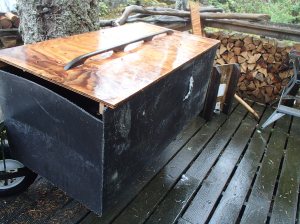

1 1/2″ input line
I have the right box. Heavy damn thing. Thick black plastic, 2 feet by 2 feet by four feet. Perfect. Thanks to Non-con, I also have the right, coarse-screen filter. I already made the fine filter using 100 micron s/s mesh. I will need to plumb the Springbox to the ‘pick-up’ collector bucket set further up the stream. The pickup itself is a bit of a filter, too. Then: from pick-up into pipe. Pipe downstream to Springbox.
I will put the Springbox out of the way of the actual current…..off to the side. If I do not move the box well out of the current, it will be caught up and swept away in the occasional roaring deluge that is part of the streams winter character. The optional gravel mentioned acts like a preliminary crude filter but it (and the water when it is filled) also serves to weigh the box down from an occasional extra stream flow.
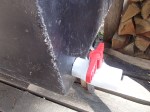
clean out valve
All this (the Springbox, filters and the feed-lines) is being made from ‘crap and junk’ saved under the house from previous projects. And from the neighbour’s accumulation, too. AND, of course, Non-con. Together we can cobble up all sorts of stuff. Well, we can make the box, anyway. Making it work properly is always a question. The hard part is getting the whole damn thing up the hill…through the bush, over the fallen trees, etc.
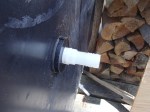
1″ outlet fitting
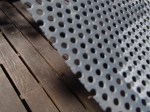
coarse filter courtesy of Noncon
And then there is Murphy to deal with. Doesn’t matter how well I design and implement this thing, it will inevitably require a hacksaw or a different fitting or something that I did not anticipate. And it is that part that is the most daunting. Forget the right screwdriver and someone has to go back to the shop (downhill, into boat, uphill and then back to boat and then back uphill)and return trip taking at least 40 minutes if you are lucky.
That’s OK, there are usually plenty of mosquitoes to keep one busy!
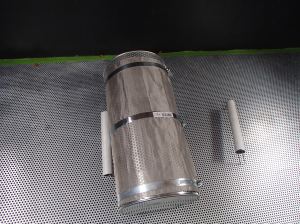
fine mesh wrapped canister filter
Obviously the right thing to do is to assemble all the tools and parts you need and then add a bunch more tools and materials for insurance and then a lot of duct tape, baling wire and chewing gum. And then hope for only one or two trips back to the shop. The problem with that technique is the stream is steep and impassible. Carrying an unnecessary tool up and down it is like Olympic training. It’s natural to try to ‘get it right the first time’.
That has never happened.
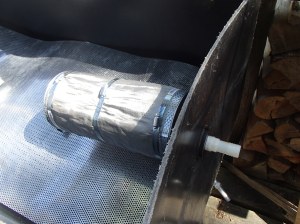
Fine filter attached to outlet fitting
The good news is that this project is waiting on every neighbour and guest we can get for this one-day project. Ideally, I could just ‘talk them all through it’ on a walkie-talkie from home while sipping mint juleps but I am not kidding myself. I will be there swatting at the mosquitoes of adversity. But, in the meantime, the box and stuff needs designing and assembling and then disassembling and transporting to the base of the stream. That and getting in the firewood and I have my work cut out for awhile.
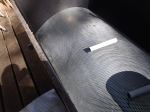
#1 of 2 coarse filters with handles
And I am not even 1/4 of the way through making the solar oven.
I wrote this blog because, as usually happens at least once a year, a city-friend asks (incredulously), “Geez, man, what the hell do you DO all day in the damn forest? I mean, seen one tree, seen ’em all, right?”
“True”, I say, (while jamming my tongue firmly in my cheek), “but every squirrel is different and they just keep us on our toes all the damn time. Crazy squirrels, eh? We are just really busy a lot with the squirrels, ya know? And then there are the ravens. Don’t get me started on the ravens! Just ask Sal about those attention-getters!”
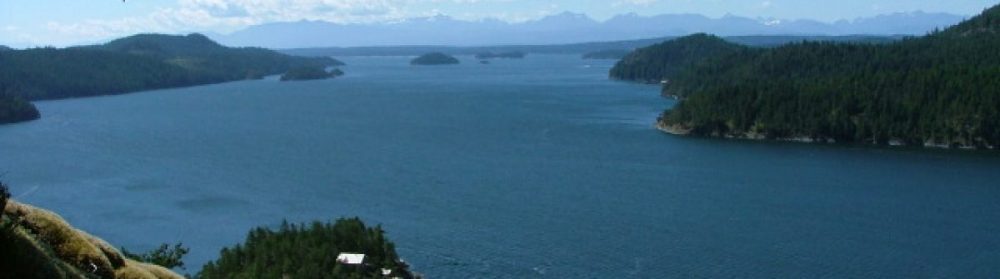


 Our Off the Grid Home