One of my friends critiqued the book and chastised me for not having set the stage more. “You should have written more about why you actually bought property where you did and stuff and why the hell you would do such a thing. I wanted to know your motivation other than mid-life crisis.”
Well, I won’t bore you with what such an answer would include but, because some others have asked questions of a similar vein, I will answer it briefly Firstly; why out here?
Well, you already know that half the answer was to get away from the rat-race. But, why here?
Canada is a big country and has some lovely spots. One can choose from many ideal spots in just about every province. But Canada is also bloody cold in a usually long winter and huge swathes of the country are under the control of bugs. Mosquitoes run Winnipeg. And most of Saskatchewan. And bugs, in general, control all of Ontario. Frankly I would prefer to be governed by the Taliban rather than insects although, to be fair, I would chafe under either. But with bugs, I would also itch and not be able to concentrate. I hate bugs.
So that leaves just the coastal regions. And, already living on the west coast made that choice much easier. But I do like PEI and Nova Scotia.
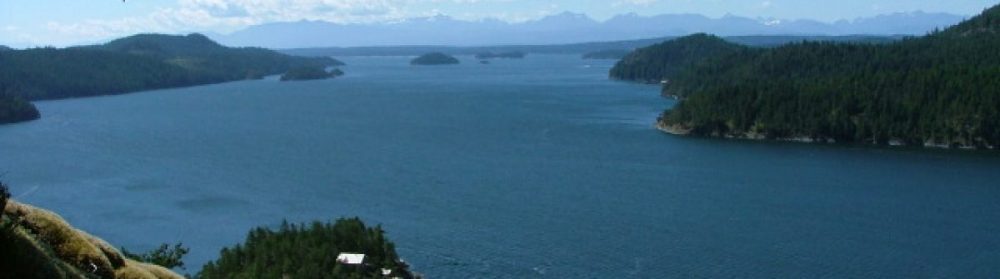
The west coast is all quite beautiful but it, too, suffers from being in Canada and even the coast can get cold, wet and miserable. In fact, it is not called the rainforest for nothing – it is all granite, rain and trees. The only part of western Canada that is habitable by my standards is the giant bath-tub ring around the Gulf of Georgia. That deep tub of water exerts a temperate climate on all the land around it for at least 20 or so miles. Go up one of the deep fiords/inlets to the head and you can actually feel the gulf’s loss of tempering influence. Go to the northern part of Vancouver Island in high summer and bundle up – it is freezing! To my way of thinking, the Gulf of Georgia is ideal. The rest of Canada is mostly harsh.
The bath-tub ring is really very, very temperate and, in some parts, quite warm and sunny. Comparatively speaking, anyway. So much so that cactus grows on mid-tub Savary Island. When we lived in Tsawwassen, we received twice the sunshine and one-third the rain that Vancouver experienced and North and West Vancouver receives that difference again. Thirty inches of rain in Tsawwassen, 60 in Vancouver and 90 in North Vancouver.
Oysters are like climate canaries for us (not such good fliers but better fryers). They grow and thrive until about 10 miles north of Campbell River. North of that, it is too cold for them. If it is 20 degrees C around Powell River, it is 10 to 12 in Port Hardy (if it ever gets that high!). I have been in a t-shirt and warm heading north in the boat and, over a five mile stretch, felt the temperature drop a significant 5 degrees (C) requiring the adding of another layer for warmth. The ‘temperate line’ is clear and distinct even if it does move around a bit with the seasons.
So that is why we chose ‘here’. But why did we choose to go at all? Like I said in the book, mostly for adventure, mostly to relieve boredom, mostly to learn and experience life in a more grounded and visceral form. To feel alive, to be more independent, to grow as human beings. To get out of the pressure cooker. All that and more. But mostly just personal reasons. Randy’s you-tube ‘Leaving’ says it best (link on the side of this blog).
But here’s the surprise: I really don’t think a person has to live remote to be off-the-grid. It helps your concentration and defines your activities more clearly but being isolated from society is impossible. You are included in society one way or another – usually, too many other ways for my liking – but you will always be connected in so many ways that OTG is really an attitude, an idea, a lifestyle more than a defined fact.
Being OTG is really just a mind-set rather than a location. A woman in a suburb in Coral Springs, Florida opted for living OTG and was persecuted by the local government for it – thus proving the validity of her choice in the first place. But she proved the point well. She went OTG in a suburb! Growing or foraging for your own food, unplugging from the umbilicals of modern life, generating your own power, practicing conservation and living as if you were in the land of plenty rather than scarcity is all it really requires. Want to try living OTG? First find your inner Luddite.
Harder to do in the city. Easier in the forest.
Just to be clear: there is a built-in irony with the exercise of moving OTG. You go to get in touch with nature, your own body and mind and to live with less. But to do that, you need to connect to the knowledge base of society, usually hire others to help and you buy prodigiously to live minimally. Worse, the more you live OTG, the more ease and comforts you try to acquire so as to be able to enjoy yourself more. This trip we bought a toaster! And I have a barge bringing me more tools! My first project this summer is to finish the lower funicular (to assist with the loading process). I may be living OTG but it seems I am trying to build the equivalent of a grid in the process.
So, what is my point? OTG is not revolutionary. It’s just a small change. A modification. An adjustment. You are not shedding your skin or undergoing metamorphosis. Basically, you are just moving house to a better neighbourhood. Is it worth the effort?
Absolutely!
 Our Off the Grid Home