As regular readers know (all 6 of you), I have branched out recently to vent, rant and comment on what I see as colossal social urban and cultural malaise or dysfunction in well, just about everything. I have even alluded to a personal tendency towards conspiracy theories.
There is the distinct possibility that I may be getting weird.
That’s kinda good for my spleen and other internal systems feeling choked and stressed (probably caused just by having to drive so much in city traffic these days) but it is not overly interesting in the long run nor is it particularly helpful to others. I can’t really apologize (and still be honest about it) but, once again, I am going to try to put some limits on it. I am going back to OTG issues.
OTG living is about independence, nature and skill building. If you have a partner, it is also about personal relationships and, if you have any kind of community, it also emphasizes traditional relationships with neighbours and any people nearby. And therein lies the first irony – people are the real grid. More people = less off-the-grid.
A few hundred years ago some independent, skilled and adventurous people struck out to live in an OTG kind of way in the new world. They came from Europe’s cities. They went forth in North America and found fertile soil and clean water and, perhaps, fruitful forests from which to carve out an existence. They were OTG but they went for the easiest-to-homestead places first. And that observation was not lost on others. Pretty soon our OTG forefathers had neighbours and then they had villages and eventually cities evolved. In other words: where the cities are is where the best OTG places are (or were).
Almost by definition, living OTG today is usually far away from the cities and the best climates, soils and conditions to serve the lifestyle. At least in any popular way. Living OTG in the 1700’s was simply a precursor to future population density. Living OTG today is almost guaranteed to remain that way.
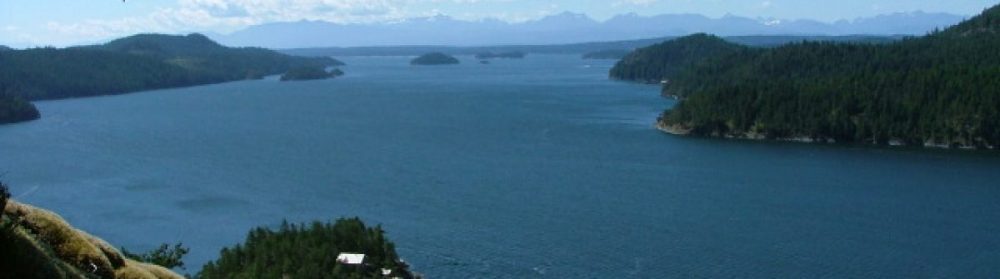
Look at our place. And the places around us (say, 100 square miles). There is precious little arable soil. There is likely more than enough for us and maybe twice as many of us but, after that number is reached, there is simply not enough arable soil. No one can farm. They grow gardens but they don’t farm. Or ranch.
Nor is the climate ideal. The Gulf Islands of BC are notoriously lacking in fresh water. The islands get plenty of rain but the topography and the rocky nature of the geography is such that not a lot is retained. The summertime is often dry on the Gulf Islands and, of course, summertime is growing season.
There are some areas of the Gulf Islands that are exceptions but they are no longer OTG and are highly valued. Bottom line: the best conditions for living OTG are found in the lower Fraser Valley. Vancouver. And we have high-rises and high density there now.
This observation is not just mine. The Agricultural Land Reserve, an august body created by the NDP in the 70’s, was intended to preserve as much arable soil as possible in an area that was rapidly being paved over. So, the double irony is that the ideal living condition seems to generate growth to the extent that what made it ideal is destroyed by the people moving there. Simply put: they paved paradise and put in a parking lot!
“So, what are you saying, Dave?”
I am saying that OTG living is not easy for a number of reasons but, if you go back to the original OTG’ers, they would never have picked the places we have available now. All the easy places have gone urban.
Of course, we have other ways to compensate for much of the difficulties of the past. Transport, technology, communications, job specializations, grocery stores and all that. But when you choose to go OTG today, you are choosing a new and complicated lifestyle, not recreating an older, simple one that comes to mind for the uninitiated. Forget the Whole Earth Catalogue. Like everything, even OTG living has evolved. It is much more complicated than it appears.
Yes, you enjoy and acquire much of what the original OTG’ers were looking for, freedom, independence and nature but you are getting there an entirely different way. Just a ‘heads-up’: don’t think of the OTG lifestyle as back-to-the-land, minimalist or simple. It simply isn’t simple anymore.
 Our Off the Grid Home