

I’ve been talking about the new marine ways and, because of the reader’s preference for less talking and more pictures (heathens!), I have done a similar format on it as I employed for the greenhouse. The two pictures of parallel beams illustrate the 6×6 ‘rails’ on which the boat will be dragged from high water (tide) to dry land (where the water does not rise to). In the final iteration, there are four beams. Sal and I still have to put the lower two on. This is how a boat ‘gets on the hard’.
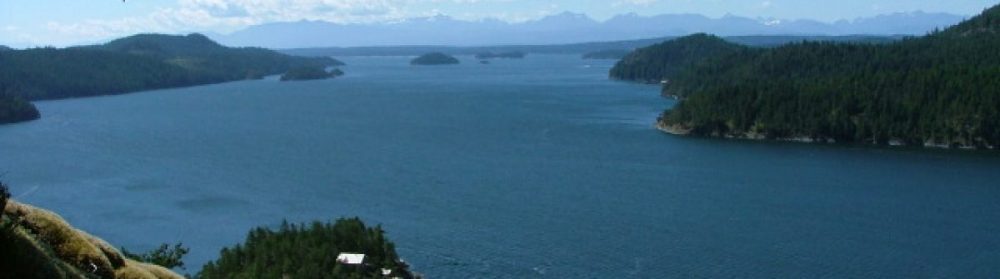
But first you have to imagine the setting. We have a tidal lagoon on the other side of the peninsula we live on (visible in the picture above). The lagoon is pretty weather protected. And the upland side of the lagoon is very weather protected. It is on the upland, forested side of the lagoon that the new marine ways is located. The area that has been committed to this project is about 20 feet by 40 feet but, of course, there is nothing but trees and rocks around that area and so we could spread out if there was reason to.
And there is reason to. Kinda. One of our land-partners occasionally ‘camps’ in that area and being able to use our work-deck* for that purpose would be of benefit to them, too. REAL benefit would be achieved if I made that deck bigger but we’ll let them decide if they want that.
I put an asterisk beside the ‘our’ work-deck reference because it is NOT our deck any longer. Once we step outside our admittedly flexible designated home-site area, the amenity one might build becomes a communal one. I may use it more in the near future than anyone else (because I currently have plans to do so) but anyone in our land group can use it whenever they want to and they do NOT need my permission. The marine ways is ‘ours’ in the group sense.
We have a few other ‘communal’ amenities here including an old cabin, the water system and we all use each other’s docks as if they were communal as well. Life kinda requires that sharing system if we are to function out here and get along as neighbours.
 But back to the half-finished ways . . . in the picture to the left, you will notice what looks like a single green post with some threaded rod sticking out. That post is 2.5″ steel pipe centred on a taller 3/4″ threaded rod with the space between the two filled with concrete. A couple of pieces of short re-bar at the bottom helped keep the base in place while the concrete set. The re-bar and threaded rod were drilled and epoxied into the granite first, of course. It’s pretty stable. There are a half a dozen of those legs on the actual marine ways and another half dozen forming the base for the deck.

The overly bright green frame for the winch is fixed to the rock underneath in much the same way, with threaded rod epoxied into the rock and the frame bolted to the rods. The winch itself, is then bolted to the green frame. Yes, that colour green was chosen simply because we had that colour of Rustoleum paint on hand. And the unique look was achieved by cutting up an old, salvaged steel battery shelf and re-fabricating it.
The winch and frame are ‘aimed at’ or oriented to face the rock wall twenty feet back of the ways. Into that wall is yet another heavy bolt epoxied in with a heavy block attached. The idea is that the person winching will be pulling a line that is centred on the ways (so the boat comes up straight) but that person can stand in the off-centre spot down closer to the beach where there is better footing.
Th e winch is an old Marpole five-ton and is simple 19th century technology. A legacy from ‘my kingdom-for-a-winch’ phase (that netted me six or more such devices, half of which are now deployed). The winch will sport 93 feet of 5/16 aircraft cable and that cable will allow me to hook onto the boat and pull it up the ways. “Why 93 feet?” Well, I ordered 100 feet from Western Equipment but when I got there, they had fitted up only 93. I guessed that they had simply run out of that cable on the one roll and hoped that 93 was close enough. That is what happened and they were right. It’s fine.
 You will also note a couple of grates mounted on the beach between the ways. Those grates were left over off-cuts from old fish farm walkways and are now re-deployed as a standing base for working on the transom of the boat that gets pulled up. Transom work is in my future. I needed a place to stand.

I can be seen in the flattering picture above working with the hammer drill that was used to do the aforementioned rock drilling. I have another drill down there as well that was used to drill through the steel. And a third drill that was used to screw down the deck. This little job required three different drills.
Note also the genset in the background. That genset will stay down there. That’s a bit more-than-usual commitment of resources but, if you are going to have a ways, you must have a means and the genset provides the means with which to do work. It’s a fairly new Wacker Neuson industrial-standard unit but looks ancient as it was a rental machine and has been treated with abuse and disrespect it’s whole short life. It was given to me and it starts every time (even when accidentally fueled with diesel). It’s like a ‘rescue’ genset. Amazing machine.
The deck is 8 feet by 16 feet. If my partners want more space, we’ll double it. There’s about $1500 of recent cash in it so far, with much of that supplemented by my inventory of junk and salvaged debris. If everything was purchased, it might cost as much as $3000 to do this project. To have this built could cost as much as $10,000 all in (remote location, custom steel work, working around tides, putting up the crew for a few days, remote premium, water taxi and a winch of that size is usually very expensive if you buy it new), not to mention the genset. In total value, it is all worth nothing, really, except to me once a year. Maybe a camping partner now and then. On the other hand, when your boat is sinking (as mine was a month or so ago), it is invaluable, essential and worth every penny and ounce of effort.
You can see by the last picture (taken from 200 feet away and 75 in elevation – from where our home site is) that the marine ways – which was a significant project for us is, in reality, a minor bit of nothing dwarfed into almost invisibility by the surroundings. Even with a boat on it, it will be ‘lost’ in the forest.

I was going to wait until we were done to post this, but I see a couple more days of putzing about, so I’ll break this into two posts . . . more to come . . .


 Our Off the Grid Home